
402C.md (1920B)
1 Source: https://codeforces.com/problemset/problem/402/C 2 3 C. Searching for Graph 4 5 time limit per test 6 7 1 second 8 9 memory limit per test 10 11 256 megabytes 12 13 input 14 15 stdin 16 17 output 18 19 stdout 20 21 Let's call an undirected graph of *n* vertices *p*-interesting, if the following conditions fulfill: 22 23 * the graph contains exactly 2*n* + *p* edges; 24 * the graph doesn't contain self-loops and multiple edges; 25 * for any integer *k* (1 ≤ *k* ≤ *n*), any subgraph consisting of *k* vertices contains at most 2*k* + *p* edges. 26 27 A subgraph of a graph is some set of the graph vertices and some set of the graph edges. At that, the set of edges must meet the condition: both ends of each edge from the set must belong to the chosen set of vertices. 28 29 Your task is to find a *p*-interesting graph consisting of *n* vertices. 30 31 Input 32 33 The first line contains a single integer *t* (1 ≤ *t* ≤ 5) — the number of tests in the input. Next *t* lines each contains two space-separated integers: *n*, *p* (5 ≤ *n* ≤ 24; *p* ≥ 0; 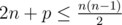) — the number of vertices in the graph and the interest value for the appropriate test. 34 35 It is guaranteed that the required graph exists. 36 37 Output 38 39 For each of the *t* tests print 2*n* + *p* lines containing the description of the edges of a *p*-interesting graph: the *i*-th line must contain two space-separated integers *a**i*, *b**i* (1 ≤ *a**i*, *b**i* ≤ *n*; *a**i* ≠ *b**i*) — two vertices, connected by an edge in the resulting graph. Consider the graph vertices numbered with integers from 1 to *n*. 40 41 Print the answers to the tests in the order the tests occur in the input. If there are multiple solutions, you can print any of them. 42 43 Examples 44 45 Input 46 47 ``` 48 1 49 6 0 50 ``` 51 52 Output 53 54 ``` 55 1 2 56 1 3 57 1 4 58 1 5 59 1 6 60 2 3 61 2 4 62 2 5 63 2 6 64 3 4 65 3 5 66 3 6 67 ```