
71B.md (1931B)
1 Source: https://codeforces.com/problemset/problem/71/B 2 3 B. Progress Bar 4 5 time limit per test 6 7 1 second 8 9 memory limit per test 10 11 256 megabytes 12 13 input 14 15 stdin 16 17 output 18 19 stdout 20 21 A progress bar is an element of graphical interface that displays the progress of a process for this very moment before it is completed. Let's take a look at the following form of such a bar. 22 23 A bar is represented as *n* squares, located in line. To add clarity, let's number them with positive integers from 1 to *n* from the left to the right. Each square has saturation (*a**i* for the *i*-th square), which is measured by an integer from 0 to *k*. When the bar for some *i* (1 ≤ *i* ≤ *n*) is displayed, squares 1, 2, ... , *i* - 1 has the saturation *k*, squares *i* + 1, *i* + 2, ... , *n* has the saturation 0, and the saturation of the square *i* can have any value from 0 to *k*. 24 25 So some first squares of the progress bar always have the saturation *k*. Some last squares always have the saturation 0. And there is no more than one square that has the saturation different from 0 and *k*. 26 27 The degree of the process's completion is measured in percents. Let the process be *t*% completed. Then the following inequation is fulfilled: 28 29  30 31 An example of such a bar can be seen on the picture. 32 33 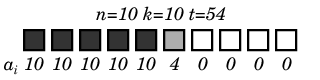 34 35 For the given *n*, *k*, *t* determine the measures of saturation for all the squares *a**i* of the progress bar. 36 37 Input 38 39 We are given 3 space-separated integers *n*, *k*, *t* (1 ≤ *n*, *k* ≤ 100, 0 ≤ *t* ≤ 100). 40 41 Output 42 43 Print *n* numbers. The *i*-th of them should be equal to *a**i*. 44 45 Examples 46 47 Input 48 49 ``` 50 10 10 54 51 ``` 52 53 Output 54 55 ``` 56 10 10 10 10 10 4 0 0 0 0 57 ``` 58 59 Input 60 61 ``` 62 11 13 37 63 ``` 64 65 Output 66 67 ``` 68 13 13 13 13 0 0 0 0 0 0 0 69 ```