
1189B.md (1892B)
1 Source: https://codeforces.com/problemset/problem/1189/B 2 3 B. Number Circle 4 5 time limit per test 6 7 1 second 8 9 memory limit per test 10 11 256 megabytes 12 13 input 14 15 standard input 16 17 output 18 19 standard output 20 21 You are given $n$ numbers $a_1, a_2, \ldots, a_n$. Is it possible to arrange them in a circle in such a way that every number is strictly less than the sum of its neighbors? 22 23 For example, for the array $[1, 4, 5, 6, 7, 8]$, the arrangement on the left is valid, while arrangement on the right is not, as $5\ge 4 + 1$ and $8 \gt 1 + 6$. 24 25 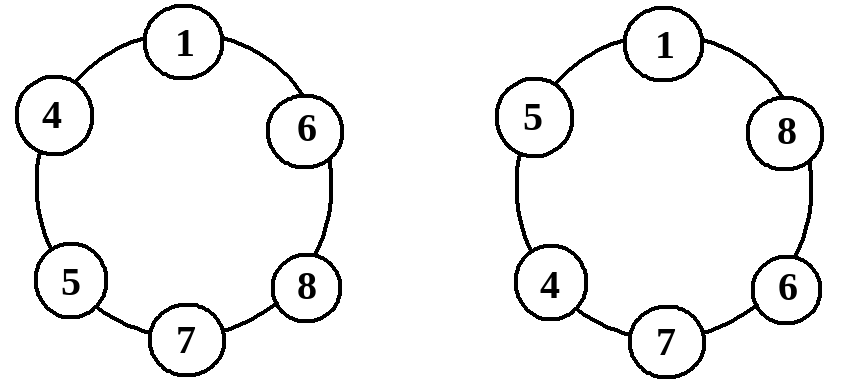 26 27 Input 28 29 The first line contains a single integer $n$ ($3\le n \le 10^5$) — the number of numbers. 30 31 The second line contains $n$ integers $a_1, a_2, \ldots, a_n$ ($1 \leq a_i \le 10^9$) — the numbers. The given numbers are not necessarily distinct (i.e. duplicates are allowed). 32 33 Output 34 35 If there is no solution, output "NO" in the first line. 36 37 If there is a solution, output "YES" in the first line. In the second line output $n$ numbers — elements of the array in the order they will stay in the circle. The first and the last element you output are considered neighbors in the circle. If there are multiple solutions, output any of them. You can print the circle starting with any element. 38 39 Examples 40 41 Input 42 43 ``` 44 3 45 2 4 3 46 ``` 47 48 Output 49 50 ``` 51 YES 52 4 2 3 53 ``` 54 55 Input 56 57 ``` 58 5 59 1 2 3 4 4 60 ``` 61 62 Output 63 64 ``` 65 YES 66 4 4 2 1 3 67 ``` 68 69 Input 70 71 ``` 72 3 73 13 8 5 74 ``` 75 76 Output 77 78 ``` 79 NO 80 ``` 81 82 Input 83 84 ``` 85 4 86 1 10 100 1000 87 ``` 88 89 Output 90 91 ``` 92 NO 93 ``` 94 95 Note 96 97 One of the possible arrangements is shown in the first example: 98 99 $4 \lt 2 + 3$; 100 101 $2 \lt 4 + 3$; 102 103 $3 \lt 4 + 2$. 104 105 One of the possible arrangements is shown in the second example. 106 107 No matter how we arrange $13, 8, 5$ in a circle in the third example, $13$ will have $8$ and $5$ as neighbors, but $13\ge 8 + 5$. 108 109 There is no solution in the fourth example.