
1266B.md (2017B)
1 Source: https://codeforces.com/problemset/problem/1266/B 2 3 B. Dice Tower 4 5 time limit per test 6 7 1 second 8 9 memory limit per test 10 11 256 megabytes 12 13 input 14 15 standard input 16 17 output 18 19 standard output 20 21 Bob is playing with $6$-sided dice. A net of such standard cube is shown below. 22 23 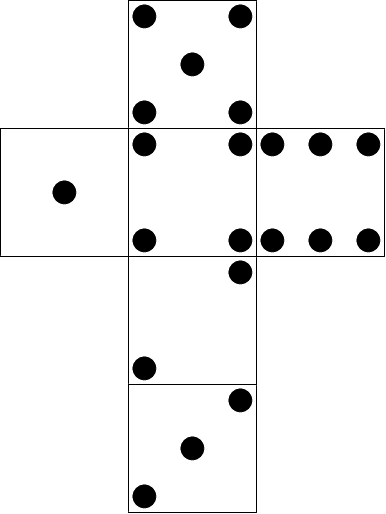 24 25 He has an unlimited supply of these dice and wants to build a tower by stacking multiple dice on top of each other, while choosing the orientation of each dice. Then he counts the number of visible pips on the faces of the dice. 26 27 For example, the number of visible pips on the tower below is $29$ — the number visible on the top is $1$, from the south $5$ and $3$, from the west $4$ and $2$, from the north $2$ and $4$ and from the east $3$ and $5$. 28 29 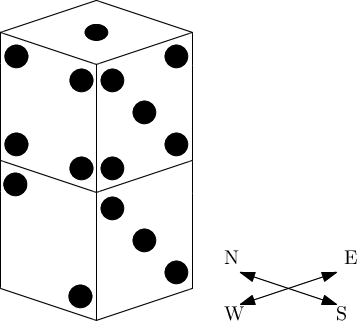 30 31 The one at the bottom and the two sixes by which the dice are touching are not visible, so they are not counted towards total. 32 33 Bob also has $t$ favourite integers $x_i$, and for every such integer his goal is to build such a tower that the number of visible pips is exactly $x_i$. For each of Bob's favourite integers determine whether it is possible to build a tower that has exactly that many visible pips. 34 35 Input 36 37 The first line contains a single integer $t$ ($1 \leq t \leq 1000$) — the number of favourite integers of Bob. 38 39 The second line contains $t$ space-separated integers $x_i$ ($1 \leq x_i \leq 10^{18}$) — Bob's favourite integers. 40 41 Output 42 43 For each of Bob's favourite integers, output "YES" if it is possible to build the tower, or "NO" otherwise (quotes for clarity). 44 45 Example 46 47 Input 48 49 ``` 50 4 51 29 34 19 38 52 ``` 53 54 Output 55 56 ``` 57 YES 58 YES 59 YES 60 NO 61 ``` 62 63 Note 64 65 The first example is mentioned in the problem statement. 66 67 In the second example, one can build the tower by flipping the top dice from the previous tower. 68 69 In the third example, one can use a single die that has $5$ on top. 70 71 The fourth example is impossible.